
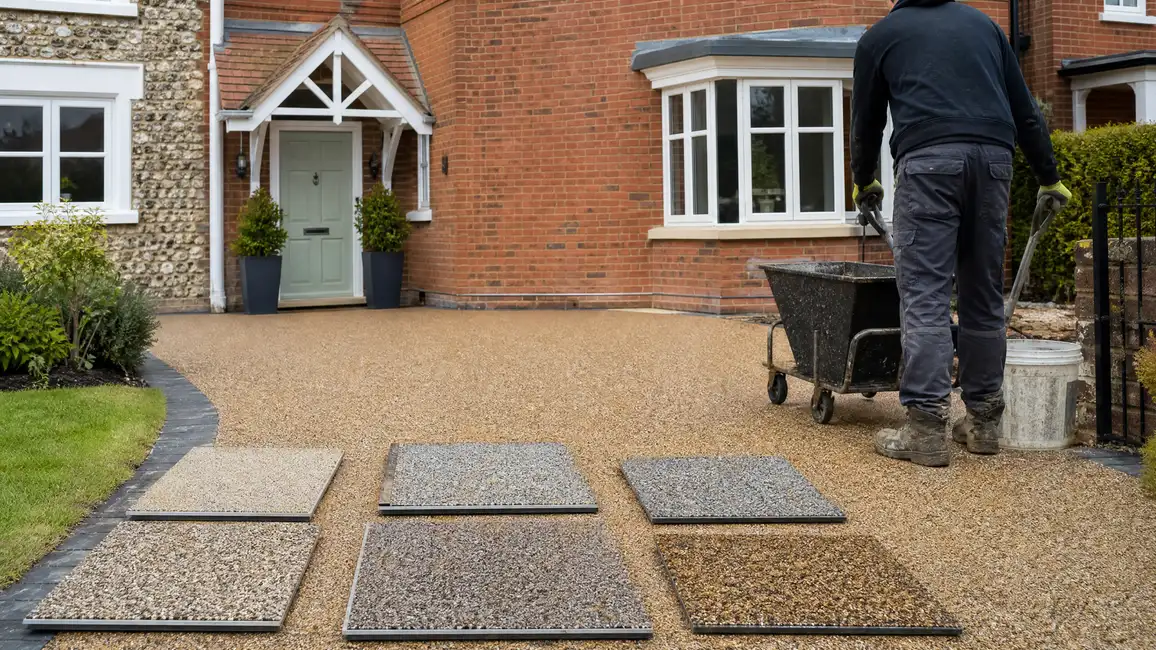
Resin Driveway Colours for Red-Brick and Ironstone Homes in Kettering – Choosing a Shade That Suits Your Frontage
Resin driveway colours for red-brick and ironstone homes in Kettering: how to match shades and avoid fading, with practical advice on Resin Bound Driveways.
Walk down almost any street in Kettering and you’ll see the same thing: warm red brick, honey-coloured ironstone, and a drive that’s been left to fade next to it. Choosing resin driveway colours is the bit most people enjoy, but it’s also where plenty regret a quick decision. At Eco Resin Driveways, we’d rather you pick a shade that flatters your house in every light, then pair it with a base that keeps it looking that way.
Which resin driveway colours go with red brick?
Neutral, slightly warm tones usually work best against red brick: soft greys, buff, light stone and mixed natural blends. They calm the brick rather than compete with it. Strong reds and oranges tend to clash, and very dark charcoal can make a modest frontage feel heavy.
Brick isn’t one flat colour, though. Kettering has plenty of orangey-red Victorian terraces, deeper plum-red bricks on 1930s semis, and paler, mottled new bricks. A grey with a cool blue edge can look cold beside orange brick, whereas a grey with brown flecks in it settles in nicely. If your house has cream render, white window frames or black guttering, pick up one of those tones in the aggregate mix.
Matching ironstone and golden stone frontages
Ironstone is more forgiving than brick, but it’s also more varied. Around Rothwell, Desborough and the older villages, the stone runs from rusty brown to a pale honey. A drive that echoes the lighter flecks in the wall usually looks best, so think sandy golds, soft browns and mixed stone blends rather than stark white or jet black.
Here’s a tip from the driveway itself: stone shows its true colour in daylight, and so does aggregate. A sample held up indoors tells you very little. That’s why our free survey includes colour samples laid against your own frontage, so you can see them beside the actual wall, gate and front door, and in your own light at different times of day.
New-build estates and conservation areas
Newer plots such as Hanwood Park and the surrounding estates often have uniform brick and tidy, shared streetscapes. Here a quieter colour tends to age better than something bold, and it keeps the street looking cohesive. Compacted subsoil under thin topsoil is common on these plots, according to Rutland Driveways’ Kettering guide (Rutland Driveways, October 2026), so the base needs as much thought as the shade.
Kettering has 26 conservation areas, including the town centre, Barton Seagrave, Burton Latimer, Geddington and Rothwell (Rutland Driveways, October 2026). If you live in one, it’s worth asking the council about any local restrictions before choosing a surface. A subtle, natural-stone-style blend is also usually the safer choice visually.
On the planning side, the Planning Portal states that no permission is needed for a new or replacement driveway of any size using permeable surfacing, or one that drains to a lawn or border (Planning Portal, Paving your front garden, 2026). A permeable resin bound driveway is built with exactly that in mind.
Does your colour choice change the price?
Sometimes, yes. Standard natural blends cost less than premium options. Premium blends or recycled glass aggregates push resin bound to around £80–£100+ per m² for materials, and bespoke blends can add 30–50% to material costs (MyBuilder resin driveway cost guide, 2026). Typical all-in pricing for Kettering is £150–£220 per m², covering dig-out, base, edging, surface and clear-up (Rutland Driveways, October 2026).
Two other things affect how colour holds up. UV-stable resin costs £5–£12 per m² extra and stops the clear resin yellowing (BestBuilders resin driveway cost guide, updated 22 August 2026). On a pale drive, we’d consider that money well spent. And the base matters more than the shade: if the old surface is failing, replacing it adds £50–£80 per m² (BestBuilders, 22 August 2026). We’ll tell you honestly whether an overlay will work or the base has to go.
Key takeaways
- Warm greys, buffs and natural stone blends sit best against red brick.
- Sandy golds and soft browns that echo the wall suit ironstone frontages.
- Judge samples outdoors against your own house, never indoors.
- UV-stable resin (£5–£12 per m² extra, BestBuilders, 22 August 2026) protects lighter colours from yellowing.
- A sound, permeable base keeps the colour looking good and keeps the drive within permitted development.
Ready to see colours on your own drive?
We cover Kettering, Corby, Wellingborough, Rothwell, Desborough and Burton Latimer. Learn how we build the base on our Resin Bound Driveways page, then Get a Free Quote or call 01536 580137 to arrange a free survey with samples laid against your frontage.


Frequently Asked Questions
For red brick, choose warm greys, buff or mixed stone with brown flecks. For ironstone, go for sandy golds and soft browns that echo the wall. Avoid strong reds, stark white and very dark shades. Seeing samples against your own frontage is the only reliable test.
Yellowing comes from the clear resin, not the stone. UV-stable resin costs £5–£12 per m² extra and stops the clear resin yellowing (BestBuilders, 22 August 2026). A properly installed drive on a sound base lasts 15–25 years (BestBuilders, 22 August 2026).
Usually, yes. Premium blends or recycled glass push materials to around £80–£100+ per m², and bespoke blends can add 30–50% to material costs (MyBuilder, 2026). Standard natural blends are cheaper. Installers' prices for the same job can also vary by 20–30% locally (MyBuilder, 2026).
Get a Fixed Price for Your Resin Driveway
Tell us roughly how big the drive is and what is there now. We visit, bring colour samples, check the base and give you a written price.